Can You Run an AI Reporting Agent in WhatsApp? Architecture, Security, and Costs
Yes, you can run a WhatsApp AI reporting agent using self-hosted, open-source infrastructure like OpenClaw to deliver scheduled business summaries and answer ad-hoc data questions directly inside team WhatsApp threads.
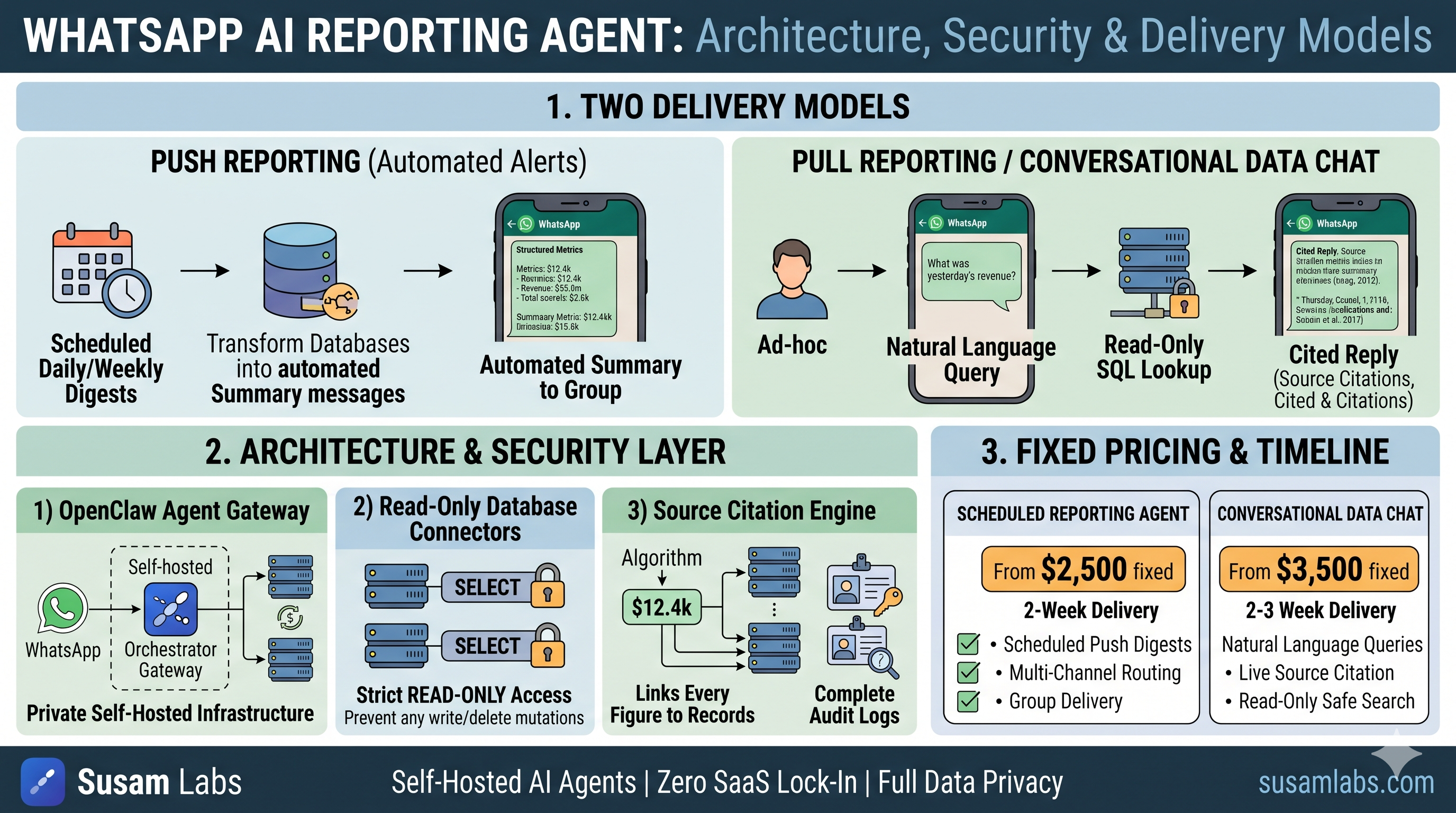
The Direct Answer: Yes, and It Runs on Your Infrastructure
Yes, you can run a whatsapp ai reporting agent that automatically delivers scheduled business reports and answers ad-hoc questions about your data inside WhatsApp threads.
For many small and medium-sized business (SMB) operators, traditional reporting breaks down not because metrics are missing, but because nobody opens dashboards. Important key performance indicators, sales numbers, and operational records sit isolated inside databases, spreadsheets, and CRMs. A reporting agent in WhatsApp brings those figures directly into the chat app your team uses every day.
Instead of requiring staff to remember login credentials, navigate analytics software, or inspect complex charts on mobile screens, an AI reporting agent translates natural-language questions into system queries, pulls the relevant figures, and posts plain-text answers back into the chat.
How a WhatsApp AI Reporting Agent Works
To run a reliable whatsapp ai reporting agent, you need three components: a messaging interface, an orchestration engine, and secure connections to your business data.
At Susam Labs, we build these deployments using OpenClaw, an open-source, self-hosted AI agent gateway. OpenClaw connects language models to messaging platforms like WhatsApp and links them securely to internal system endpoints.
An operational reporting setup relies on two core delivery models:
- Scheduled Push Reporting: The agent runs on a set schedule (daily, weekly, or month-end). It queries your connected database, CRM, or spreadsheets, generates a plain-language executive summary, and posts the report directly into a targeted WhatsApp group or individual chat.
- Ad-Hoc Conversational Queries (Pull Reporting): A team member types a natural-language question directly into WhatsApp—such as asking for yesterday's revenue or updated lead counts. The agent interprets the request, executes a read-only query against the underlying system, and replies in the thread with the specific numbers and source record references.
Data Security, Self-Hosting, and System Architecture
Data privacy is the main concern for business operators introducing AI into communication channels. Routing internal financial records or customer metrics through proprietary third-party SaaS middleman tools creates unnecessary security risks.
Using a self-hosted gateway like OpenClaw resolves these risks through four primary architectural controls:
1. Self-Hosted Deployment The agent software runs entirely on your own infrastructure. Proprietary company data does not pass through or reside on third-party agency servers. You retain total control over hosting, environment configuration, and access keys.
2. Read-Only System Connectors The agent interfaces with your primary databases, spreadsheets, or CRM using strict read-only permissions. This structural boundary prevents the model from updating records, deleting rows, or modifying data regardless of user input.
3. Source Citation and Verification Un-grounded language models risk hallucinating numbers. To maintain data accuracy, the reporting agent cites the specific source record or dataset used for every metric generated. Operators can verify any reported figure directly against the source CRM or database entry.
4. Per-User Permissions and Audit Logging Not every employee should access every company metric. The agent can enforce per-user permission controls so individuals receive data only for records they are already authorized to inspect. Additionally, a central audit log records every query asked and report generated for accountability.
Push Summaries vs. Conversational Data Chat
Depending on operational requirements, teams usually implement scheduled summaries, conversational querying, or a hybrid of both.
Push Reporting: Scheduled Summaries Scheduled push reports target daily operational alignment without requiring manual dashboard checks.
- Daily Digests: Generated every morning to summarize yesterday's sales figures, open tickets, or inbound lead volume.
- Weekly and Month-End Summaries: High-level reviews comparing recent performance against past benchmarks.
- Format: Concise, plain-text messages structured for quick reading on mobile devices without relying on chart screenshots.
Pull Reporting: Conversational Data Chat Conversational reporting turns WhatsApp into an on-demand business intelligence tool.
- Instant Metric Lookup: Staff ask direct questions in plain language and receive precise numerical answers within seconds.
- Schema Mapping: The agent maps ambiguous internal terms to underlying database fields accurately.
- Multi-System Queries: When information is split across multiple tools—such as a CRM and a accounting sheet—the agent queries both to deliver a unified answer.
Implementation Timelines and Fixed Costs
Deploying a whatsapp ai reporting agent does not require long multi-month engineering projects. Fixed-scope builds allow organizations to ship functional tools in weeks.
Through our AI automation services, Susam Labs delivers these capabilities as productised outcomes:
- Scheduled WhatsApp Reporting Agent: Built on OpenClaw starting at $2,500 fixed. Delivered in 2 weeks. Includes scheduled daily, weekly, or month-end plain-language summaries on self-hosted infrastructure.
- Conversational WhatsApp Data Chat Agent: Built on OpenClaw starting at $3,500 fixed. Delivered in 2–3 weeks. Includes read-only connectors, source record citations, per-user permissions, and audit logging.
For broader back-office improvements, our agentic workflow automation services also include custom n8n pipelines starting from $1,800 / ₹1.5L for task automation, lead enrichment, and CRM routing.
Note that third-party WhatsApp Business API usage costs are billed separately by your API provider based on outbound and inbound message volume.
What to Evaluate Before Building
Before launching an AI reporting setup on WhatsApp, confirm these technical requirements with your engineering team or implementation partner:
- Avoid Platform Lock-In: Ensure workflows run on open tools like n8n or self-hosted platforms like OpenClaw. You should own all source code, workflows, credentials, and runbooks at handover.
- Verify Read-Only Database Access: Never connect generative AI agents to production databases using write or delete privileges.
- Require Source Citations: Every reported figure must link back to an identifiable database record or line item.
- Enforce Human Oversight: For complex workflows extending beyond reporting into external task execution, maintain explicit human-in-the-loop checkpoints.
If you want to scope a custom setup for your team, you can contact Susam Labs to review your infrastructure and data sources in a 30-minute scoping call.
Summary
Running a WhatsApp AI reporting agent allows SMBs to push scheduled metrics and answer ad-hoc data questions directly inside daily team chats. By leveraging self-hosted tools like OpenClaw, read-only system connectors, and transparent source citations, teams automate operational reporting securely without locking proprietary data into third-party SaaS platforms.
Common questions
- What software is used to build a WhatsApp AI reporting agent?
- Susam Labs builds WhatsApp reporting agents on OpenClaw, an open-source, self-hosted AI agent gateway. It connects language models to messaging channels like WhatsApp while linking to your internal tools, spreadsheets, and databases.
- How much does a WhatsApp AI reporting agent cost?
- A scheduled WhatsApp reporting agent starts at $2,500 fixed and ships in two weeks. A conversational agent that answers ad-hoc questions about your data starts at $3,500 fixed and ships in two to three weeks. WhatsApp API fees are billed separately by the provider.
- Where is our business data stored when using a reporting agent?
- Your data stays on your own infrastructure. OpenClaw agents are self-hosted on your system, using read-only connectors to your databases or CRM. Susam Labs hands over full source code, credentials, and runbooks with no vendor lock-in.
- Can team members ask ad-hoc questions in WhatsApp?
- Yes. Conversational agents interpret natural language questions, run read-only queries against connected systems, and return answers with source record citations directly in the WhatsApp thread while respecting per-user permission rules.