How to Give an AI Agent Safe Access to Internal Tools
Safe AI agent tool access requires typed schemas via Model Context Protocol (MCP), read-only scope boundaries, human-in-the-loop gating for write operations, and self-hosted execution with full audit logging.
The Direct Answer
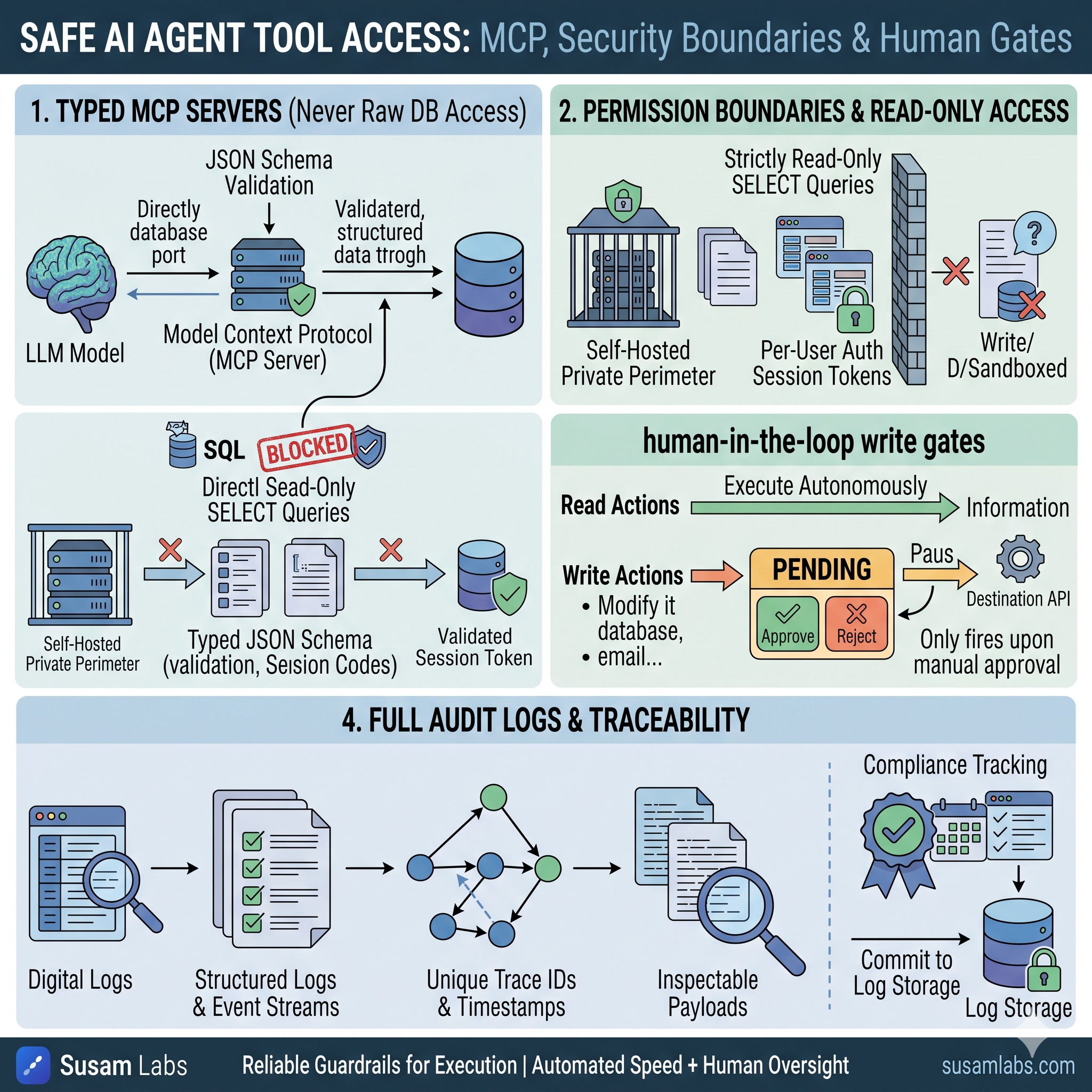
Giving an AI agent safe access to internal tools requires strict execution isolation, standardized tool definitions via Model Context Protocol (MCP), read-only database connections by default, human-in-the-loop approval for write actions, and self-hosted workflow orchestration with complete execution auditing.
You should never hand an LLM raw database credentials, unconstrained REST API tokens, or arbitrary shell access. Treat every output generated by a model as untrusted input. Tool parameters must be validated against rigid schemas, access rights must map directly to per-user permissions, and execution runbooks must run on infrastructure you control.
At Susam Labs, when engineering ai agent tool access mcp architecture into production systems, we rely on a layered control boundary. Here is how to structure safe tool integration step by step.
1. Avoid Direct Database Access: Interface via Typed MCP Servers
Passing raw SQL capabilities or broad database access to an LLM creates an immediate vulnerability to indirect prompt injection and parameter hallucination. If an attacker injects malicious text into a record retrieved by the model, or if the model misinterprets an instruction, an unconstrained connection can result in unintended updates or severe data exfiltration.
Instead, abstract your systems behind structured interfaces using the Model Context Protocol (MCP). MCP provides an open standard for exposing tools, resources, and prompt templates to language models in a typed, predictable manner.
Why MCP Tool Definitions Protect Your Stack
- Strict Schema Enforcement: Tools exposed via an MCP server accept defined TypeScript or JSON Schema types rather than free-form queries. If a model attempts to pass an invalid parameter, execution fails at the validation layer before touching your database.
- Explicit System Boundaries: The agent only sees the specific functions declared by the MCP server (e.g.,
get_user_by_idorfetch_daily_revenue). It cannot execute arbitrary SQL statements or access unmapped tables. - Decoupled Business Logic: Tool execution logic resides inside your internal microservices or workflow engines, not inside the prompt context.
When we build multi-agent pipelines and internal copilots, tool design starts by defining clear MCP boundaries to enforce structural predictability.
2. Enforce Permission Boundaries and Read-Only Connectors
Security model design should assume the agent will occasionally generate wrong parameters or attempt actions outside its original intent. Defensive boundary architecture minimizes the blast radius of any individual execution.
Read-Only Data Access
For search, business intelligence, and reporting agents, expose strictly read-only connections. If an agent needs to retrieve daily numbers from a database, CRM, or spreadsheet, supply a connection string or service account restricted exclusively to SELECT or read operations. If an agent lacks write privileges at the database level, no prompt injection or model error can alter your records.
Per-User Scopes
An agent operating on behalf of a human user must never bypass the application's existing authorization matrix. If User A does not have permission to view payroll records in your HR portal, the agent invoked by User A must not be able to execute tool calls that pull payroll data.
Your tool interface layer must accept the authenticated user's session context and apply those exact permission filters before returning data to the agent context.
Self-Hosted Infrastructure
Data privacy and access safety require controlling where execution happens. Sending sensitive internal payload data to third-party multi-tenant orchestration cloud services introduces vendor risk and compliance compliance gaps.
Self-hosting platforms like n8n or the open-source OpenClaw agent gateway ensure that data stays inside your enterprise network. In an OpenClaw or n8n deployment, data processing occurs entirely on your servers, credentials remain in your environment, and execution logs stay accessible to your security team.
3. Enforce Human-in-the-Loop Gateways for Destructive Actions
While read-only tasks like query assembly and report generation can safely run autonomously, any operation that modifies state, updates a CRM, moves funds, or sends external communications requires explicit approval mechanisms.
Operational Approval Queues
Do not permit an agent to execute write actions immediately upon generating a tool call payload. Instead, capture the tool invocation in a pending state and route it to an approval queue.
For example, in outbound lead generation or automated back-office workflows: 1. The agent researches the target system and drafts the proposed payload (e.g., an email draft or status update). 2. The payload is pushed to an administrative dashboard, a Slack channel, or a review queue. 3. A human operator reviews the proposed action, verifies the parameters, and clicks approve. 4. Upon approval, the workflow engine fires the final API call to the destination system.
This pattern eliminates runaway execution loops and protects system integrity while retaining the productivity gains of automated research and draft generation.
4. Implement Comprehensive Audit Logging and Tracing
To safely run AI agents in production, every tool invocation, prompt input, and execution result must be fully auditable.
Essential Audit Requirements
- Structured Tool Logs: Log the exact timestamp, user ID, system context, generated tool name, input parameters, and raw output for every single tool call.
- Execution History Tracking: Use orchestration engines like n8n where every run leaves a persistent, inspectable execution trail. When a workflow fails or behaves unexpectedly, engineers can inspect the exact input payload that triggered the behavior.
- System Traceability: Attach unique trace IDs across agent reasoning loops and internal service calls to track how multi-step reasoning decisions propagate through your internal infrastructure.
How We Implement Safe AI Architectures at Susam Labs
At Susam Labs, we build AI-native products end to end, including agentic workflow automation on n8n, self-hosted OpenClaw agents, and custom multi-agent architectures using MCP. We ensure every integration operates within fixed safety boundaries:
- Read-Only Data Chat Agents: Self-hosted OpenClaw agents running on your infrastructure that allow teams to chat with business data in WhatsApp using read-only connectors and strict source citation.
- Lead Enrichment & Automated Workflows: n8n pipelines with explicit human-in-the-loop approval steps before external sends or CRM updates.
- Custom Agentic Orchestration: Multi-agent pipelines integrated with typed MCP tools, comprehensive eval suites, prompt guardrails, and full execution tracing.
Whether you need fixed-scope AI automation or dedicated engineering capacity, explore our AI automation and engineering services or check our standard engagement models on our pricing page.
Practical Engineering Takeaways
- Standardize on MCP: Expose internal tools using Model Context Protocol servers with strict JSON or TypeScript schemas rather than granting open API access.
- Isolate Permissions: Default to read-only connections and enforce per-user authorization boundaries at the API layer.
- Gate Every Write: Insert explicit human-in-the-loop checkpoints before any agent action that mutates state or sends outbound communication.
- Keep Infrastructure Self-Hosted: Run workflow orchestrators like n8n and OpenClaw on your own servers so credentials and sensitive internal data never leave your boundary.
- Maintain Complete Audits: Log every prompt input, tool payload, and execution output for deterministic troubleshooting and compliance.
If you are planning an internal agent deployment and need hands-on technical guidance, get in touch with our team to scope your architecture.
Common questions
- What is the Model Context Protocol (MCP)?
- Model Context Protocol (MCP) is an open standard that allows language models to interface safely with external data sources and tools through strictly typed schemas, resource definitions, and prompt templates.
- How do you prevent an AI agent from running unauthorized database writes?
- You prevent unauthorized writes by connecting the agent via read-only database connections, enforcing per-user scopes, and routing state-changing tool requests through human-in-the-loop approval queues.
- Why is self-hosting important for AI agent tool access?
- Self-hosting on platforms like n8n or OpenClaw ensures your API keys, database credentials, and internal customer data remain inside your corporate network rather than passing through third-party cloud services.