How to Score and Route Inbound Leads Automatically
Automated lead scoring routing requires an event-driven n8n pipeline that enriches inbound form fills, evaluates explicit ICP criteria, assigns CRM ownership, and alerts sales teams in under a minute.
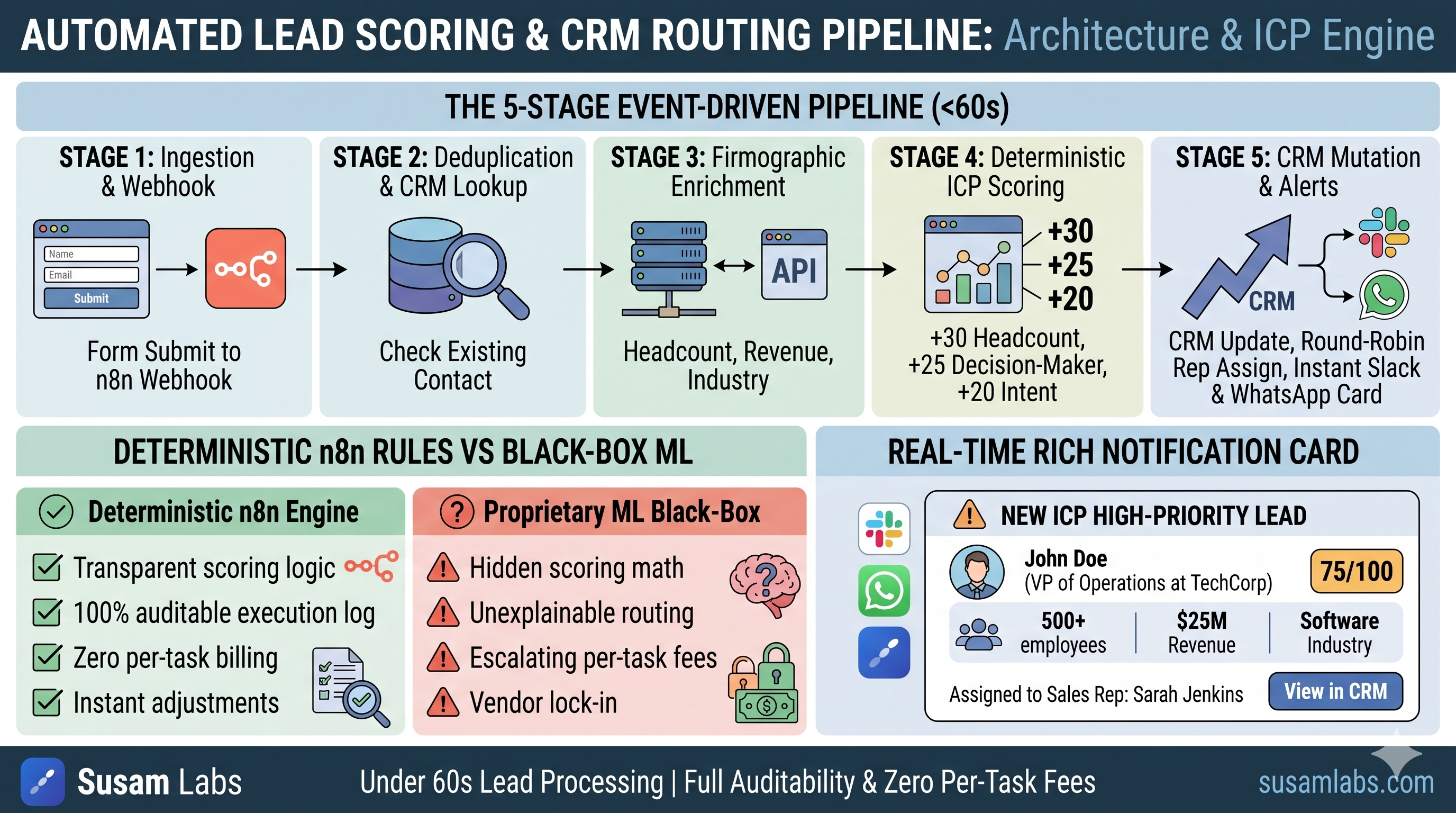
To implement effective automated lead scoring routing, you need an event-driven execution pipeline sitting directly between your inbound web forms and your CRM. Instead of paying sales reps to perform manual research or relying on opaque, expensive black-box scoring add-ons, a modern workflow pipeline intercepts inbound form triggers, enriches contact and firmographic data, evaluates explicit Ideal Customer Profile (ICP) rules, updates CRM records, and dispatches rep notifications—all in under 60 seconds.
At Susam Labs, we build this infrastructure on open platforms like n8n to give engineering and sales ops teams total visibility over every execution step. Here is a technical breakdown of how to architect, score, and route inbound leads automatically without losing control of your data or workflow logic.
The Architecture of an Inbound Scoring and Routing Pipeline
An automated lead pipeline works as a linear state machine. Each inbound request must pass through five discrete execution stages before a sales representative ever touches the deal.
1. Ingestion and Webhook Handling When a prospect submits a form, downloads a asset, or replies to a campaign, the source system fires an HTTP POST payload to a designated n8n webhook endpoint. The payload contains raw inputs: email address, full name, company name, and self-reported form fields.
2. Deduplication and CRM Lookup Before making external API calls, the workflow queries your CRM (such as HubSpot or Salesforce) using the lead's email domain. If an active deal, account owner, or existing contact record exists, the workflow tags the event and routes it according to existing account assignment rules rather than creating duplicate entries.
3. Firmographic and Contact Enrichment If the lead is new, the pipeline queries your external firmographic data providers. It retrieves key missing attributes: - Company employee count and annual revenue - Industry sector and sub-categories - Corporate headquarters location - Job title seniority and department
By running enrichment automatically prior to scoring, your lead forms remain short—requiring only an email and name—which protects conversion rates while still gathering the data needed for precise evaluation.
4. Rule-Based ICP Scoring The enriched payload enters a deterministic scoring engine. Rather than relying on obscure machine-learning scores that reps cannot interpret, the engine applies explicit, human-readable logic. Points are added or subtracted based on clear criteria: - Firmographic fit: +30 points for target headcount (e.g., 50–500 employees), -20 points for out-of-region accounts. - Persona fit: +25 points for decision-maker titles (e.g., Director, VP, CTO), +5 points for individual contributors. - Intent/Action: +20 points for high-intent requests (e.g., demo booking), +5 points for content downloads.
5. CRM Mutation, Assignment, and Notification Leads meeting or exceeding your ICP threshold (e.g., 60+ points) are flagged as high priority. The pipeline uses round-robin assignment logic across qualified reps, mutates the CRM deal owner, sets the lead status, and dispatches a rich notification card to your internal team channel via Slack or WhatsApp.
Why Deterministic Logic Beats Machine Learning Black Boxes
Many sales organizations fall into the trap of purchasing proprietary predictive scoring products. These tools use proprietary algorithms to output a single obscure score. When a rep asks why a lead was assigned to them—or why a seemingly good account was marked low priority—nobody can inspect the mathematical reasoning.
Deterministic, rule-based scoring engines built inside n8n solve this adoption problem. Your sales leadership defines the ICP rules in plain English, and an engineer or workflow author implements them as readable code or node conditional branches. If your sales team decides that company size should carry higher weight than job title, you adjust the score weight in the workflow configuration in minutes.
Furthermore, using an open execution platform ensures that every single lead evaluation leaves a complete audit trail. You can review the exact execution log in n8n to see what firmographic data was returned, which scoring branches were triggered, and when the API call updated your CRM.
Implementing Lead Pipelines with n8n
We build production-ready automation systems on n8n because it runs on infrastructure you own and control. Proprietary SaaS automation tools charge escalating per-task fees that penalize you as inbound volume grows. Building your lead pipeline on n8n means zero platform lock-in and complete data security.
In a standard setup, our team configures the entire flow: - Data provider integrations: Connecting your existing firmographic and contact search APIs. - Transparent scoring configuration: Setting up ICP rules your team can read and tweak without writing code. - Round-robin routing: Enforcing fair, automated assignment logic across rep tiers based on region, deal size, or schedule availability. - Auditing and error handling: Including automatic retries and real-time failure alerts if an external data provider or CRM API returns an error.
For companies looking to eliminate manual lead qualification completely, explore our AI automation and agentic workflow services to see how we build custom lead processing pipelines. We offer a fixed-price n8n lead enrichment pipeline implementation delivered in about two weeks, giving you a turn-key solution running inside your own infrastructure.
Real-Time Alerts via Slack and WhatsApp
Timing is critical for inbound conversion. A qualified lead left sitting in an unmonitored CRM queue for hours is significantly less likely to convert. Once the workflow scores a lead above your defined threshold, it immediately formats and posts an actionable alert card to a dedicated team channel.
These alert cards contain: - Contact name, title, and verified LinkedIn profile - Enriched firmographic metadata (headcount, location, revenue) - Assigned CRM owner and total calculated ICP score - Direct deep links to open the record inside your CRM
By providing all relevant context directly inside the messaging tools your team already uses every day, sales representatives can respond to inbound interest in minutes rather than hours.
If you want to review your sales automation infrastructure or discuss automating your inbound pipelines, you can contact our engineering team to schedule a technical scoping call.
Takeaway
Replacing manual lead qualification with an automated lead scoring routing pipeline built on n8n ensures that every inbound contact is enriched, evaluated against transparent ICP rules, assigned to the right owner, and alerted to your team in under a minute.
Common questions
- How quickly does an automated n8n pipeline enrich and route an inbound lead?
- An n8n lead enrichment pipeline processes inbound form fills, enriches contact data, calculates ICP scores, updates CRM ownership, and dispatches Slack notifications inside 60 seconds with no human step.
- How much does a fixed-scope lead enrichment and routing pipeline cost?
- An n8n lead-enrichment and routing pipeline from Susam Labs starts at $2,900 fixed, delivered in about two weeks on your own infrastructure.
- Who owns the workflow code and infrastructure after deployment?
- You own all workflows and infrastructure. Workflows run on your own n8n instance with full source access, credential control, and written documentation. There is no vendor lock-in.