n8n vs Zapier vs Make: Which Automation Platform Should Small Teams Build On?
For small teams evaluating n8n vs Zapier vs Make, n8n is the clear choice for scalable workflow automation because it runs on infrastructure you own, eliminates per-task pricing meters, and avoids vendor lock-in.
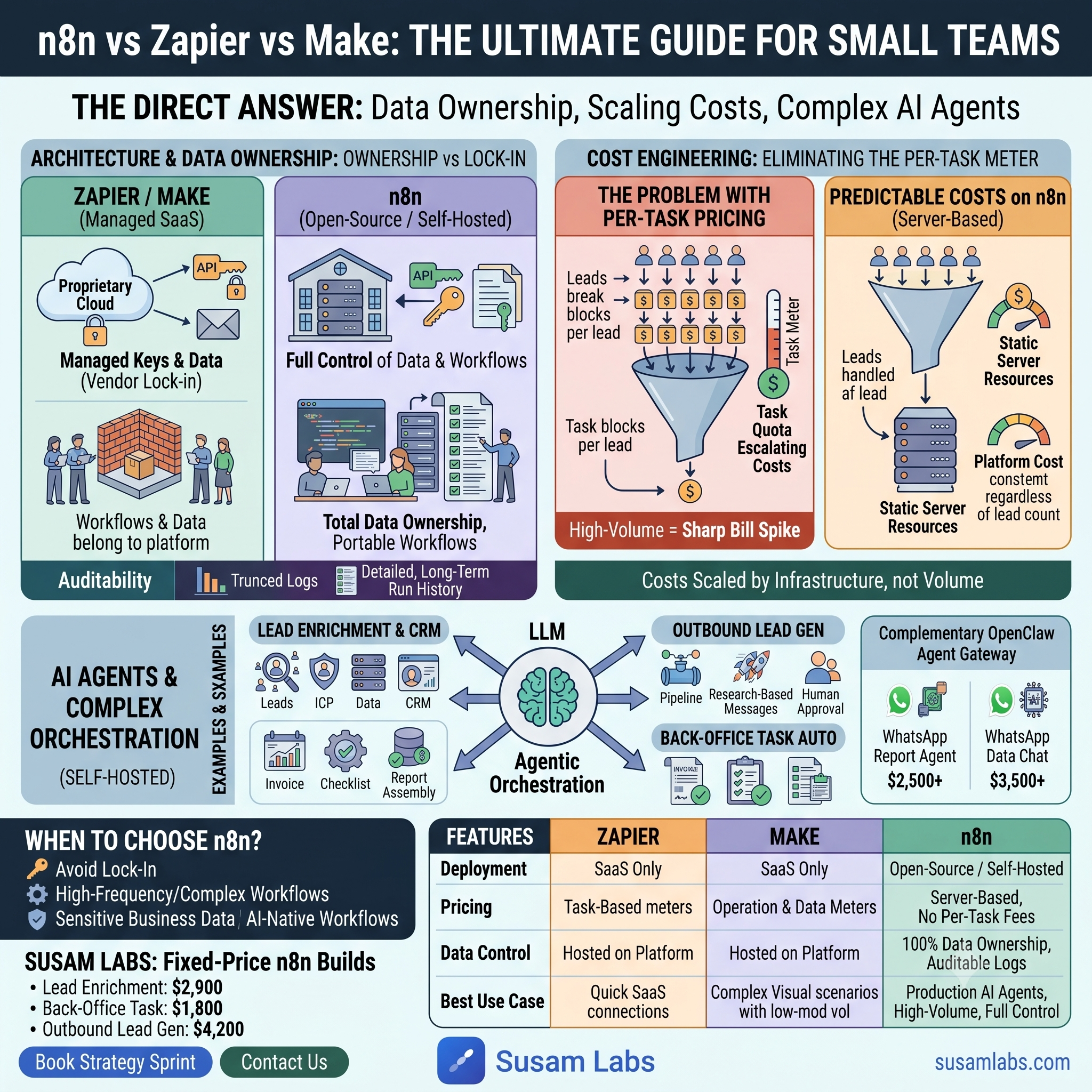
The Direct Answer for Small Teams
When evaluating n8n vs Zapier vs Make, the right choice for a growing small team comes down to three factors: data ownership, execution cost scaling, and flexibility with complex AI agentic workflows.
If your team needs quick, simple web-app triggers without managing infrastructure, hosted SaaS platforms like Zapier or Make offer initial convenience. However, if you are building core business processes, lead enrichment systems, back-office task automations, or complex multi-step AI agent workflows, n8n is the superior choice.
Because n8n is an open-source workflow automation platform that runs on infrastructure you own, it eliminates vendor lock-in and per-task pricing meters. You maintain full access to code, execution logs, and credentials while running high-frequency automations at a predictable infrastructure cost rather than paying a variable tax on every execution step.
At Susam Labs, we build agentic workflow automation on n8n because small teams deserve full control over their core processes and data. You can explore our AI automation services to see how we deliver production-ready workflows directly into your own infrastructure.
Architecture and Data Ownership: Open-Source vs Vendor Lock-In
The fundamental difference between n8n and platforms like Zapier or Make lies in deployment architecture and control over your data.
Hosted SaaS vs Infrastructure You Own
Zapier and Make are fully managed cloud applications. Your workflow logic, API keys, and intermediate execution data reside on their proprietary servers. If you decide to migrate or change providers later, you cannot simply export your workflows and run them elsewhere—you face complete vendor lock-in and must rebuild your logic from scratch.
In contrast, n8n is open-source. Workflows are deployed into an n8n instance on infrastructure you own and control. When Susam Labs builds an n8n pipeline for a client, the workflow JSON, configuration, credentials, and run history belong entirely to the client. If you ever stop working with an external studio, your automations keep running uninterrupted on your servers without any ongoing licensing dependencies.
Auditability and Compliance
In proprietary workflow systems, detailed execution logs can be constrained by tier limits or truncated over time. n8n records a complete run history for every execution. Every lead's path, data payload, external API response, and decision branch is fully auditable. This visibility is vital when running sensitive back-office tasks, financial reconciliations, or customer data enrichment pipelines.
Cost Engineering: Eliminating the Per-Task Meter
As small teams scale their operations, workflow execution volume grows exponentially. A single inbound lead might require five to ten sequential steps: validating email syntax, pulling firmographic data, scoring against ideal customer profiles, routing to CRM, and posting alerts to communication channels.
The Problem with Per-Task Pricing
Platforms like Zapier and Make rely on task-based or operation-based billing meters. Every step in a multi-node workflow consumes a unit of quota. When small teams launch high-volume workflows—such as automated prospect research or continuous data syncs—their platform bills escalate sharply alongside execution volume.
Predictable Infrastructure Costs on n8n
n8n breaks this model. Because n8n runs on self-hosted infrastructure, there is no per-task pricing meter. Whether a workflow runs ten times a day or ten thousand times a day, your platform cost remains tied strictly to your underlying server resources.
This structural difference changes how teams design automations. Instead of truncating workflow steps or skipping enrichment checks to save execution credits, teams can build robust, multi-step error-handling loops and thorough validation pipelines without financial penalty.
AI Agents and Agentic Workflow Orchestration
Modern automation requires more than passing static JSON payloads between REST endpoints. Teams need agentic orchestration: workflows that integrate large language models (LLMs), Model Context Protocol (MCP) tools, context retrieval, and human-in-the-loop checkpoints.
Building Advanced Pipelines on n8n
n8n provides native capabilities for complex AI orchestration. Small teams can build advanced agentic systems, including:
- Lead enrichment and CRM routing: Automatically enriching inbound leads with firmographic data, applying ICP scoring rules, routing qualified opportunities in the CRM, and triggering instant alerts.
- Outbound lead generation: Performing per-prospect research, generating personalized first touches using LLMs grounded in target websites, and running human-in-the-loop approval queues before message dispatch.
- Back-office task automation: Executing invoice reconciliation, onboarding checklists, and automated report assembly between systems lacking native integrations.
For organizations requiring specialized messaging interfaces alongside n8n, Susam Labs also deploys OpenClaw—an open-source, self-hosted AI agent gateway—to deliver scheduled WhatsApp business reports and conversational chat-with-your-data agents that query databases directly.
If you are evaluating how to structure your automation architecture or need fixed-scope execution, review our transparent service pricing and engagement models.
Detailed Comparison Breakdown
To evaluate n8n vs Zapier vs Make effectively, consider how each platform handles core operational requirements:
Zapier
- Deployment: Managed SaaS cloud only.
- Pricing Model: Tiered subscriptions based on task volume meters.
- Data Control: Workflows and logs hosted on Zapier infrastructure.
- Best Use Case: Quick, low-volume connections between standard web SaaS apps without developer resources.
Make
- Deployment: Managed SaaS cloud only.
- Pricing Model: Tiered subscriptions based on operation counts and data usage.
- Data Control: Visual scenario builder hosted on Make infrastructure.
- Best Use Case: Visual multi-step workflows with moderate volume requirements where hosted convenience is prioritized over code ownership.
n8n
- Deployment: Open-source, self-hosted on your own infrastructure or managed cloud options.
- Pricing Model: Server-based infrastructure cost without per-task execution fees.
- Data Control: 100% data ownership, auditable execution histories, and portable workflow definitions.
- Best Use Case: Production AI agents, high-volume lead pipelines, custom back-office task automation, and teams requiring full control over data privacy and source code.
When Should a Small Team Choose n8n?
Small teams should build on n8n if they meet any of the following criteria:
- You want to avoid vendor lock-in: You want full ownership of your automation code, credentials, and workflow definitions.
- You handle high-frequency or complex workflows: You do not want your operational budget penalized by per-step task meters as volume expands.
- You process sensitive business data: You need self-hosted execution where data never leaves your infrastructure boundaries.
- You are building AI-native workflows: You need deep integration with LLMs, custom MCP tools, evaluation loops, and human-in-the-loop approvals.
For teams that want production-grade n8n automations shipped without spending months on internal engineering, Susam Labs offers productized, fixed-price builds. For example, our n8n lead enrichment pipeline starts at $2,900 fixed (delivered in 2 weeks), back-office task automation starts at $1,800 fixed (delivered in 1–2 weeks), and complete outbound lead generation engines start at $4,200 fixed (delivered in 3 weeks).
If you are unsure which automation path fits your business goals, you can book an AI strategy sprint or reach out via our contact page to scope your project.
Practical Takeaway
For small teams, Zapier and Make offer quick initial setup for lightweight task connections, but n8n is the clear choice for teams building durable, scalable, and cost-effective automation infrastructure. With n8n, you own the workflows, retain your run history, avoid per-task execution taxes, and retain complete control over your AI and data pipelines.
Common questions
- Why choose n8n over Zapier or Make for small business automation?
- n8n runs on infrastructure you own with no per-task pricing meter and no vendor lock-in. Unlike Zapier or Make, every execution is fully auditable, and you retain complete ownership of all workflow code and data.
- Do we own the n8n workflows built by Susam Labs?
- Yes. n8n workflows are delivered directly into your own n8n instance. You get the source code, credentials, and a written runbook on handover. There is no hosting dependency on Susam Labs.
- How much does a custom n8n workflow build cost?
- Susam Labs builds productised n8n automations at fixed prices: back-office task automation starts at $1,800, lead enrichment pipelines start at $2,900, and outbound lead generation engines start at $4,200.
- Can n8n handle AI agent orchestration and LLM integrations?
- Yes. n8n natively orchestrates multi-step AI agents using LLMs, Model Context Protocol (MCP) tools, custom API connectors, evaluation steps, and human-in-the-loop approvals.