What Is an AI Agent, Really? (And How It Differs From Chatbots and RPA)
An AI agent autonomously plans tasks, executes multi-step reasoning, and uses external tools via protocols like MCP, whereas chatbots only generate turn-by-turn text and RPA bots rely on rigid, deterministic scripts.
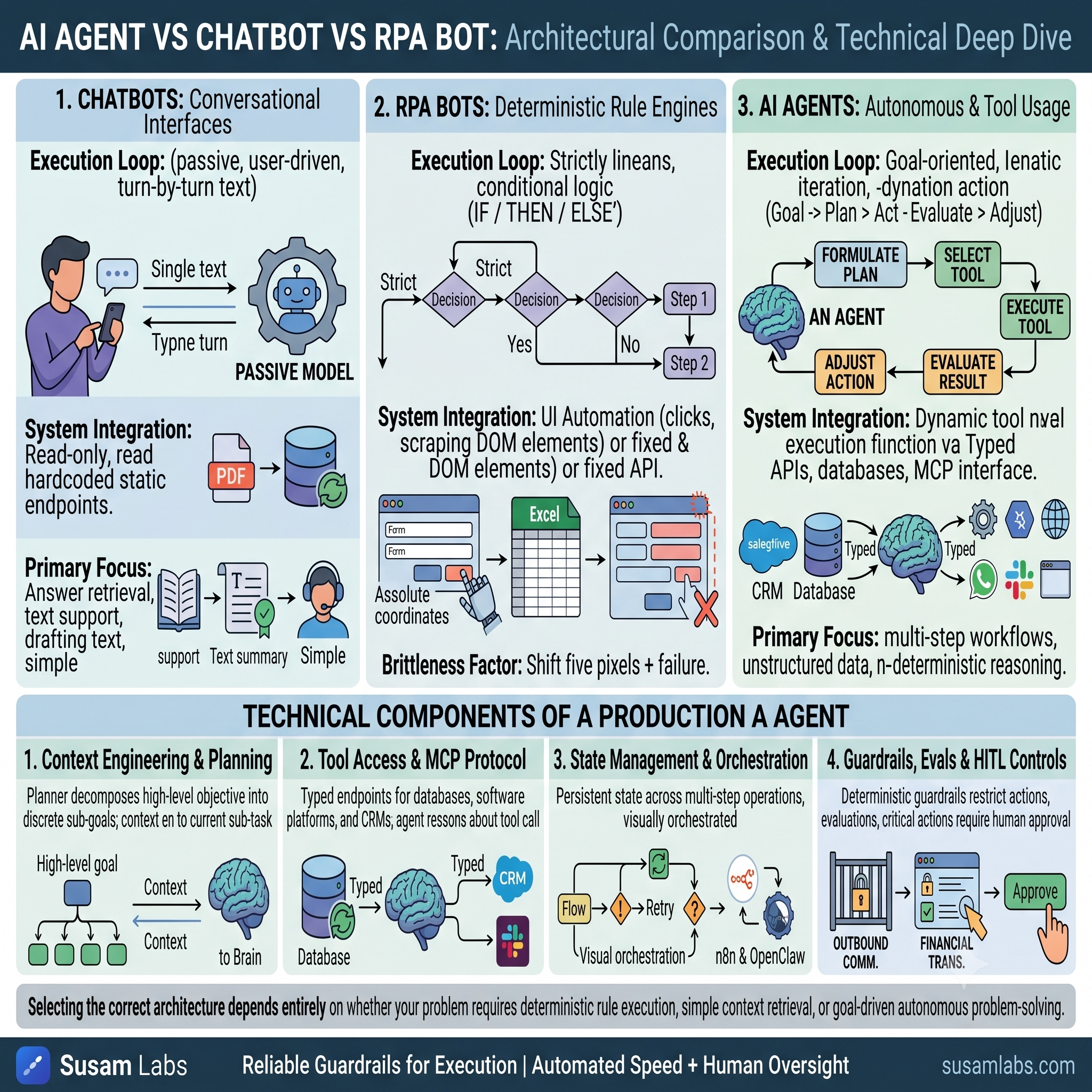
An AI agent is an autonomous software system that receives a high-level objective, formulates a multi-step plan, calls external tools to interact with real systems, evaluates its own execution against defined outcomes, and dynamically adjusts its actions until the task is complete. Unlike traditional tools, an agent operates with a degree of non-deterministic reasoning backed by evaluations and guardrails.
When technical evaluators analyze an ai agent vs chatbot vs rpa stack, the fundamental distinctions lie in autonomy, execution context, and handling of non-deterministic decisions. A chatbot is primarily a user-facing conversational interface built for turn-by-turn text generation. Robotic Process Automation (RPA) is a deterministic execution engine that relies on hardcoded, fixed rules to mimic manual keystrokes or static API calls. An AI agent bridges the gap: it brings the reasoning capabilities of large language models to non-deterministic tasks, while leveraging tool execution and structured orchestration to complete end-to-end operational workflows.
Chatbots vs RPA vs AI Agents: The Architectural Core
To choose the right architectural pattern for an enterprise system, you must understand how these three technologies process inputs, handle state, and execute actions.
1. Chatbots: Single-Turn Conversational Interfaces
Traditional chatbots (and basic LLM chat wrappers) process a text prompt, pass it into a model with context from a system prompt or a basic retrieval-augmented generation (RAG) vector index, and return a textual response.
- Execution loop: Passive, user-driven, single-turn or multi-turn text exchange.
- System integration: Typically read-only or limited to hardcoded static endpoints.
- Failure mode: Hallucinations or unhelpful responses when the user input strays from pre-indexed documents.
- Primary focus: Answer retrieval, drafting text, and handling simple front-line support queries.
While a chatbot can answer questions about your data, it does not autonomously log into a database, verify system schema changes, write a complex query, double-check its own syntax, execute the query, and push the verified result into a third-party pipeline without explicit user instruction for every step.
2. RPA: Deterministic Rule Engines
RPA tools automate repetitive, high-volume back-office administrative tasks by recording and replaying precise procedural steps. They excel at moving data between systems with static structures, such as reading an Excel file with explicit cell locations and uploading the values into a legacy ERP portal.
- Execution loop: Strictly linear, conditional logic (
IF / THEN / ELSE). - System integration: UI automation (clicking buttons, scraping DOM elements) or fixed API integrations.
- Failure mode: High brittleness. If a button shifts five pixels on a web form or an incoming invoice format changes slightly, the RPA script fails and requires engineering intervention.
- Primary focus: High-volume, deterministic task execution where variations do not exist.
RPA handles predictable structured workflows exceptionally well, but it cannot process unstructured context, interpret ambiguous instructions, or handle unexpected operational edge cases.
3. AI Agents: Autonomous Planning and Tool Usage
An AI agent combines the language understanding of LLMs with tool access, structured state management, and continuous feedback loops. Rather than relying on rigid conditional scripts or simple text replies, an agent breaks a goal down into sub-tasks, selects appropriate tools from a registry (such as Model Context Protocol servers), runs those tools, inspects the returned payload, and determines the next step.
- Execution loop: Goal-oriented, dynamic iteration (
Plan -> Act -> Evaluate -> Adjust). - System integration: Dynamic tool execution via APIs, databases, browser automation, and MCP interfaces.
- Failure mode: Loop divergence or incorrect tool parameter selection, which must be gated by evaluations, guardrails, and explicit human-in-the-loop checkpoints.
- Primary focus: Complex, multi-step workflows involving unstructured data, non-deterministic reasoning, and multi-system execution.
The Technical Components of an AI Agent
Building production-ready AI agents requires moving past simple prompt engineering into systems engineering. At Susam Labs, through our AI development services, we structure AI agents around four core technical components:
1. Context Engineering and Planning
When a high-level task enters an agent system, the planner module decomposes the objective into discrete sub-goals. Context engineering ensures that the model receives the exact context, schema definitions, and constraints required for the current sub-task without overwhelming the token window or introducing context drift.
2. Tool Access and Model Context Protocol (MCP)
Agents gain agency through execution capabilities. By implementing standard interfaces like the Model Context Protocol (MCP), agents expose typed endpoints for databases, internal software platforms, CRMs, and communication channels. The agent reasons about which tool to call based on typed schemas, constructs the arguments, calls the tool, and parses the structured response.
3. State Management and Orchestration Platforms
Agents must persist execution state across multi-step operations. Orchestration platforms like n8n or OpenClaw provide the foundational routing, logging, and state management required for enterprise deployment. For instance, n8n handles visual orchestration, retry handling, and error alerts for backend processes, while OpenClaw serves as a open-source, self-hosted AI agent gateway connecting models to messaging interfaces like WhatsApp.
4. Guardrails, Evals, and Human-in-the-Loop Controls
Production AI agents cannot run entirely unmonitored on sensitive operational systems. Deterministic guardrails restrict the actions an agent can take, while systematic evaluation frameworks verify prompt and model changes before deployment. Critical milestones—such as sending outbound communication or executing financial transactions—are gated by human-in-the-loop approval queues to maintain operational integrity.
Practical Implementation Patterns
Understanding the theoretical difference in an ai agent vs chatbot vs rpa framework helps technical teams select the right pattern for specific engineering requirements:
- Data Querying and Summarization: If you need daily business metrics posted to team channels, a chatbot simply answers when prompted. An agent built on OpenClaw pulls data on a schedule from databases or CRMs, verifies figures, formats plain-language business summaries, delivers them to WhatsApp, and handles follow-up ad-hoc analytical queries directly within the thread.
- Inbound Lead Processing: An RPA bot can copy form responses into a spreadsheet line-by-line. An agentic workflow built on n8n receives the lead, enriches firmographic data from third-party services, runs an LLM evaluation step to score the lead against Ideal Customer Profile (ICP) criteria, determines round-robin routing logic, and triggers Slack alerts—completing end-to-end execution in under a minute.
- Outbound Pipeline Generation: An outbound lead generation agent builds prospective lists from defined ICP targets, verifies email deliverability, performs per-prospect research across external sites, drafts personalized communications grounded in site data, and routes drafted sequences to a human approval queue before initiating sends.
For organizations establishing fixed-scope AI automation builds, reviewing a clear pricing breakdown helps align operational requirements with fixed delivery timelines.
Summary Takeaway
Do not confuse conversational interfaces or rigid scripts with AI agents. A chatbot talks about work, an RPA bot blindly executes fixed procedural steps, and an AI agent reasons, plans, and executes complex multi-step workflows across systems using tools and runtime evaluations. Selecting the correct architecture depends entirely on whether your problem requires deterministic rule execution, simple context retrieval, or goal-driven autonomous problem-solving. If you are evaluating how to build or deploy agentic infrastructure within your technical organization, get in touch with our team.
Common questions
- What is the key difference in an ai agent vs chatbot vs rpa comparison?
- Chatbots handle turn-by-turn text generation, RPA bots run fixed conditional scripts for deterministic tasks, and AI agents autonomously plan, evaluate, and execute multi-step workflows using external tools.
- Why do AI agents use orchestration platforms like n8n or OpenClaw?
- Platforms like n8n and OpenClaw provide robust state management, error handling, audit logging, and tool connectivity, allowing agents to execute securely on self-hosted infrastructure.
- How do human-in-the-loop controls prevent agent execution errors?
- Human-in-the-loop checkpoints pause execution at key decision points—such as outbound communications or data writes—requiring explicit human approval before the agent proceeds.